
'If we want to pivot meaningfully from a services-driven economy to a technology and manufacturing-led one.'

'The hearing is not adversarial but inquisitorial in nature -- it allows Sebi to examine the context, the strategy, and the intent behind the trades, particularly when algorithmic and expiry-day trading are involved.'

BSE 200 companies together paid 5,819.75 crore as remuneration to their CEOs and directors in FY25, up from 5,352.8 crore a year earlier.

The more things change, the more they remain the same for corporate India. In the April-June 2025 period (Q1FY26) - for the ninth consecutive quarter - listed companies witnessed only single-digit revenue growth, while their core earnings, excluding other income and one-time gains, contracted for the second time in four quarters. This comes as firms brace for the impact of 50 per cent US tariff on Indian goods.

Global emerging market investors are sharply cutting back on India, making it the largest underweight market, as funds rotate into China, Hong Kong, and South Korea amid tariff shocks and valuation concerns.

The combined market capitalisation of the country's top five IT firms that are part of the BSE Sensex is down 24 per cent since January and their valuation has slipped to lowest levels in the past five years.

India's top information- technology (IT) services companies, all cash-rich, have been tightfisted about ploughing back their earnings in new projects or acquisitions and the bulk of the profits have been distributed to shareholders through dividend and share buybacks. In the past 10 years (that is, excluding the current one), the firms have reinvested in growth and expansion only around 13.5 per cent of the cash flow generated from their operations.

India's initial public offering (IPO) market is rewriting the rules of sectoral dominance, with a diverse slate of companies entering the stock market arena.

'Sebi's measures are necessary to align the derivatives market with its underlying cash market, as the current disconnect is unsustainable.'

'Listing of scaled Indian subsidiaries of multinational corporations as well as of Indian conglomerates continues to remain a key theme for IPOs in India.'

The Jane Street-Sebi saga is more than a legal dispute -- it's a litmus test for India's ambitions as a global financial hub.
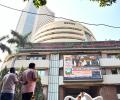
'BSE has facilitated nearly Rs 35 trillion in capital raising across multiple segments.'
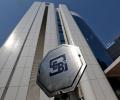
Sebi aims to stay proactive as HFT and quant firms like Citadel Securities, Optiver, Millennium, and IMC Trading are expanding rapidly in India, which is home to the world's largest derivatives market by contracts traded.

Promoters of India's top private listed companies have cut their stakes sharply since 2021, taking advantage of elevated valuations and reshaping ownership dynamics in the market. Holdings of promoters in the top 200 privately owned listed firms declined nearly 600 basis points (bps) to 37 per cent at the end of FY25, from 43 per cent in FY21.

The AV Birla group flagship Grasim Industries has been an outperformer on the bourses. The company's stock price is up 56.5 per cent in the last

Tata Sons' dividend from Tata group companies for last financial year is expected to show a decline of 3.5 per cent to Rs 36,514 crore from Rs 37,832 crore a year earlier. This should be the first year-on-year decline in Tata Sons' dividend in the last nine years. The holding company had last reported a decline in FY16, when its proceeds had gone down 42.5 per cent to Rs 6,898 crore from Rs 11,993 crore a year earlier.

The interplay between domestic and foreign capital will shape India's equity markets.

Banks have outperformed the broader market in the past six months and most of the leading lenders have given positive returns to investors compared to a negative return delivered by benchmark indices.

Early-bird results for the January-March 2025 quarter (Q4FY25) suggest a slowdown in earning growth for India Inc, despite a benign cost environment that has led to an improvement in margins. The combined net profit (adjusted for exceptional gains and losses) of 175 early-reporting companies rose by 3.8 per cent year-on-year (Y-o-Y) in Q4FY25, marking the slowest growth in 17 quarters.

Domestic institutional investors (DIIs), mostly mutual funds and insurance companies, overtook foreign portfolio investors (FPIs) in ownership of NSE-listed companies in the March quarter of 2025. According to Prime Database, DIIs held a 17.62 per cent stake, up from 16.89 per cent in the December 2024 quarter.
 © 2026 Rediff.com - Advertise with us - Disclaimer - Privacy Policy - Sitemap - Feedback - About us - Terms of use - Grievances